A data warehouse without the migration.
Not a shorter migration. No migration. Ward reads Iceberg, Delta, Parquet and your existing warehouses where they already sit, on read-only credentials scoped to tables you name, and a queryable warehouse exists on top of them in hours.
Three different things people mean by this, and all three hold.
No lift and shift of the lake
Your objects stay in your bucket, your region and your retention policy. Ward reads Iceberg, Delta and Parquet in place and queries them where they are. There is no second copy to secure, budget for, or reconcile when the two disagree.
No re-platforming of the sources
POS, ERP, finance, ticketing and the warehouse you already run stay exactly as they are. Ward connects on a read-only service account per source. Nothing upstream is upgraded, migrated or asked to change shape to make the connection work.
No cutover window
There is no freeze, no dual-run period and no weekend. The systems of record keep running and keep being the systems of record. If Ward is switched off, they are untouched and your team is where it started.
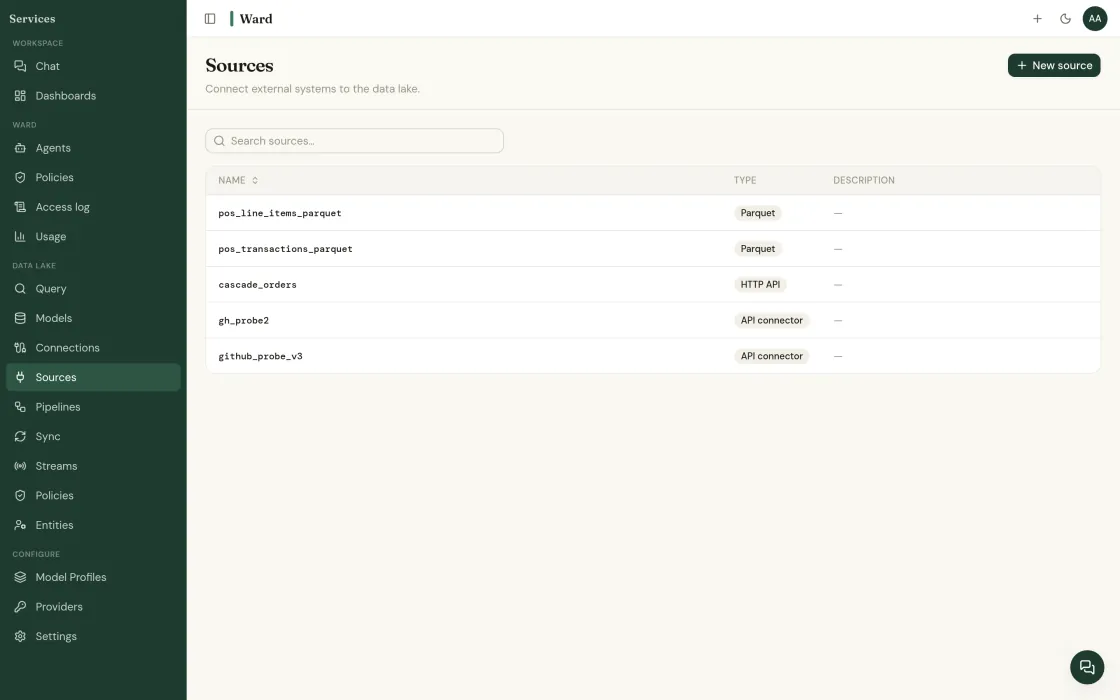
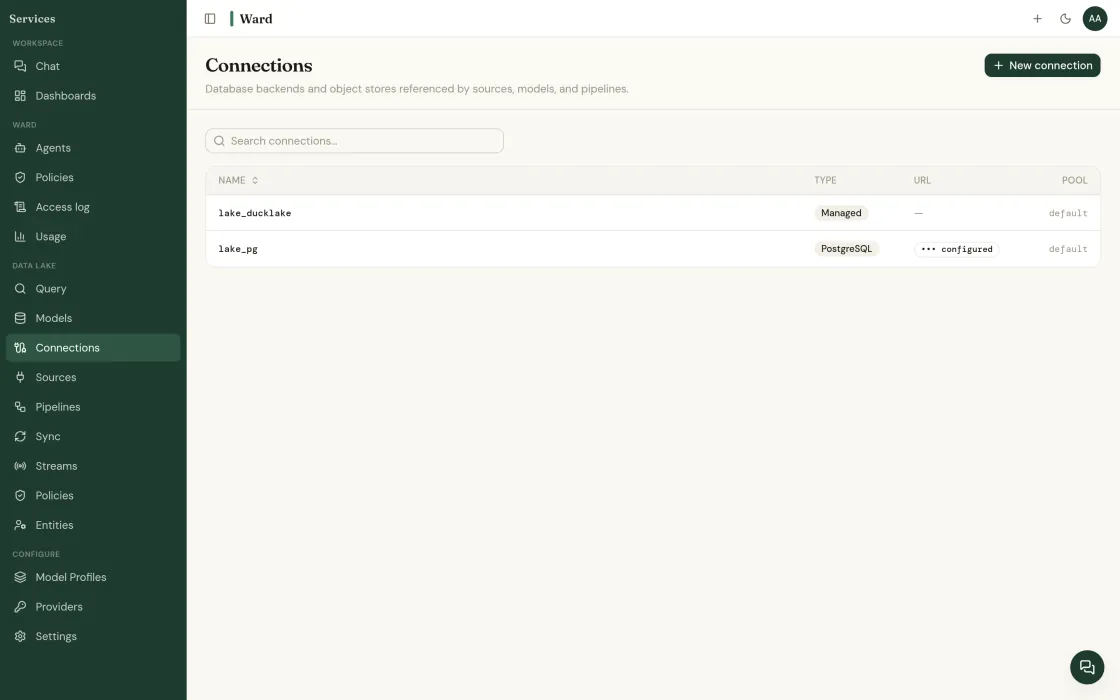
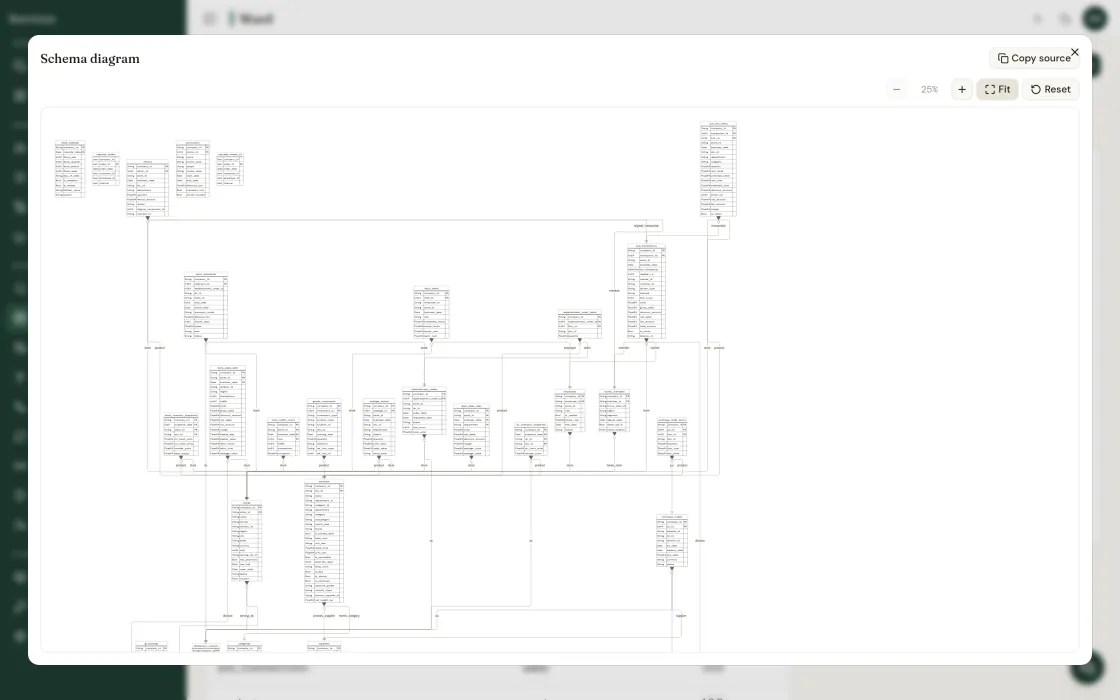
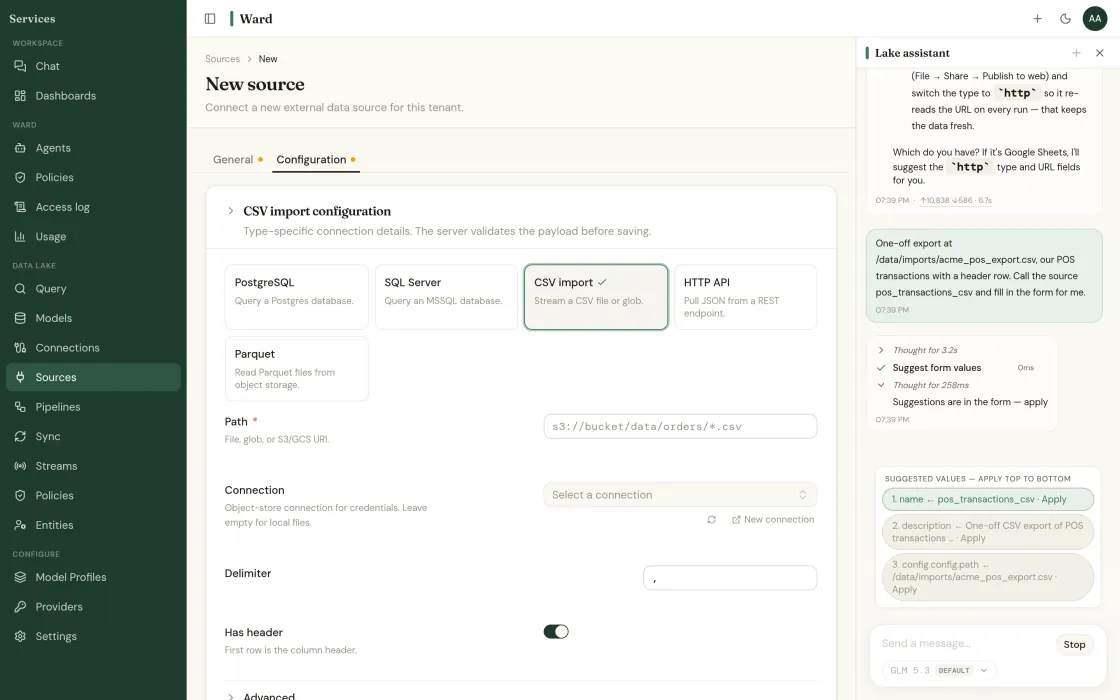
Federate or ingest, per source, toggled in place.
Your systems on the left, marked read-only. The warehouse filling on the right. Which mode each source runs in is a setting, not a rebuild.
A destination, a platform, or a layer.
Three ways to end up with a warehouse. They differ most in what your team is holding afterwards.
| A warehouse migration | A platform you run (Cloudera and peers) | Ward | |
|---|---|---|---|
| What you are buying | A destination, plus the project to reach it | A data platform you deploy and operate where your data lives | A layer that reads what you already run |
| Where the data ends up | Copied into the new warehouse | In open formats on storage the platform manages | Where it is now. Ward reads it in place. |
| What your team installs | Pipelines, orchestration, a modelling layer | The platform, its services and its operations | Nothing. Ward is a console and a read-only credential per source. |
| Time to a query you trust | Quarters, and the schedule is the metric definitions | A deployment project, then the same modelling work | Hours to a first query. Days to definitions your team signs off. |
| The metric definitions | Rewritten by hand, which is what takes the quarters | Yours to model on the new platform | Ward AI reconstructs them from the reports you publish. You approve the diff. |
| Reversal | A second migration | A decommissioning project | Revoke the credential. Nothing moved. |
| Where it fits best | You have decided the destination and have the team for it | Estates that need the platform on-premises or in a controlled region | You want the warehouse now and cannot justify the project yet |
Cloudera stands in here for a real category and not for a weaker product. A platform you run where your data sits is the right answer for estates with residency and on-premises constraints Ward does not pretend to solve. The distinction is a platform versus a layer, and the two are not in the same argument.
What does move, stated plainly.
Read in place is the default and not an absolute. Three things are worth knowing before your security review asks.
- Query results and the cached intermediates behind them live in the Ward tenant for as long as your retention setting says, because a warehouse that recomputes everything from source on every question is not a warehouse.
- Where federation is too slow for a workload, ingest is available per source and is a choice you make, not a default we make. The Architecture panel shows which mode each source is in.
- Writes are off. A write back to a system of record requires an explicit per-table grant, and it leaves a record with the identity that made it.
The rest of what a security review asks, pre-answered: the trust center and the document room.
No migration window, and here is the schedule that replaces it.
Read-only for the first six weeks. A measured answer by day 90. The same four dates quoted on every other page of this site.
-
48 hoursFirst insight cards
From a read-only connection. Findings on your own data, not a sandbox and not a slide.
-
Week 2Findings ranked by dollars
Stores, SKUs and vendors ranked by what they cost you, with the cause named and the SQL one click under every number.
-
Week 6First gated write
One playbook, one system of record, blocked on an approver role you named. Everything before this is read-only.
-
Day 90The number, either way
Measured KPI delta against the metric agreed on day one. If it did not move, the pilot ends.
Ward makes money one way: 5% of the model compute that routes through it, metered on your own provider keys and billed monthly in arrears. No license, no seats, no platform fee. Setup is a one-time package if you want a named engineer for training and guidance, and it starts at $0.
- 5% of model spend, the only recurring fee
- Setup from $0, invoiced once
- Cancel any time, 30 days notice
Migration, federation and what actually moves.
Asked by the person who would own the project, and answered without pretending the trade-offs are not real.
Yes. Query engines can read open table formats where they already sit, so the warehouse becomes a layer over your storage rather than a destination you copy into. Ward reads Iceberg, Delta and Parquet in place and federates to the databases and warehouses you already run, on read-only credentials scoped to tables you name. What you get is a queryable warehouse with shared metric definitions on top of it, without a lift and shift, a cutover window, or a second copy of anything.
A zero-migration data warehouse is one where the data stays in its existing storage and systems, and the warehouse layer queries it where it is. The pattern is usually built on open table formats like Apache Iceberg and Delta Lake plus federated query to operational sources. The trade is real: federation can be slower than a local copy for heavy workloads, so most teams federate by default and ingest the few tables that justify it.
Cloudera fits the case where the data cannot leave a specific place. It is a data platform you deploy and operate where your data lives, including on-premises and in controlled regions, and it works in open formats rather than locking you into a vendor warehouse. The distinction against Ward is platform versus layer. With Cloudera you run the platform, which is the point of it when residency or on-premises is a hard constraint. With Ward there is nothing to install: it reads the systems you already run and the warehouse exists on top of them.
ETL copies data on a schedule into a warehouse, and every query then runs against the copy. Federated query leaves the data where it is and pushes the query out to each source at read time. ETL gives you speed and a stable snapshot at the cost of a pipeline to maintain, a copy to secure, and freshness measured in hours. Federation gives you current data and nothing to move, at the cost of latency on heavy joins and a dependency on the source being reachable. Most production stacks end up with both, chosen per source rather than decided once.
Plan in quarters rather than weeks for a full migration. Moving the bytes is rarely the hard part. The schedule goes on rebuilding the metric definitions, because almost nobody has written down what a metric means, only the reports that use it, and every one of those has to be reproduced and reconciled against the old system before anyone will trust the new one. That reconstruction is the reason a warehouse project outlives the quarter it was scoped in.
Not by default. Ward connects on read-only credentials scoped to the tables you name and reads your lake and warehouses in place. Query results and cached intermediates live in the Ward tenant under a retention policy you set, because a warehouse that recomputes everything from source on every question is not a warehouse. Ingest is available per source where federation is too slow for a workload, and it is a choice you make rather than a default. Writes are off until you grant them per table.
Query the lake you already pay for.
A running warehouse over the storage you already own, with no migration window and no second copy.
How the warehouse works →- Reads S3, Iceberg, Delta and Parquet in place. No lift and shift.
- Incremental sync with change data capture where the source supports it.
- Ward AI profiles what lands and drafts the cleaning and conforming rules. You review the diff in the console before any of it binds.
Point it at one source and see.
Read-only, scoped to tables you name. Revoke the credential and nothing has moved.
Read-only to start · your LLM keys · SOC 2 Type II underway · or book a call directly
Find out what your data has been hiding.
Tell us about your operation. We’ll show you the problems Ward catches, and the ones your current tools miss.