Free to deploy. Paid on compute.
Five percent of what you spend on models. Nothing else recurs.
Ward does not license software. The console, every connector, the semantic layer, every agent and every user are free. Ward meters the model tokens that route through it and bills 5% of that spend. If you want a named engineer for training and guidance, setup is a one-time package, and the smallest one is $0.
Three lines. Two of them can be zero.
No seats, no license, no annual plan. Deploy the whole platform, pay a share of the compute it uses, and buy our time only if you want it.
- Every connector and the semantic layer
- Unlimited agents and users
- Policies, audit log, SSO/SAML and RBAC
- Community support
- Each call goes to the cheapest model that clears the bar
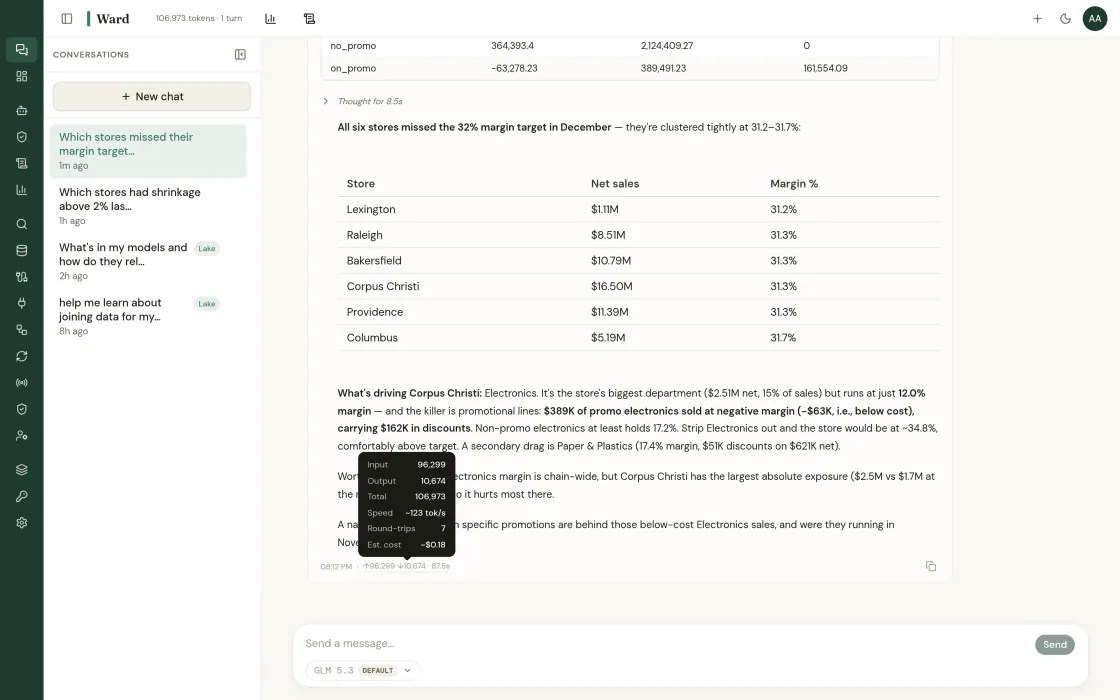
- Per-message cost on every answer
- Budgets and hard caps per department and user
- The only recurring fee Ward charges
- Self-guided: $0
- Guided, two weeks: $7,500
- Managed, six weeks: $20,000
- Program, multi-entity: from $50,000
Self-serve is in early access while account creation finishes. Request access and it goes out with the next batch.
How the 5% is counted.
Every question and every agent run ends in a call to a model provider. Ward routes it, meters it, and takes five percent of what the provider charged. That is the entire recurring fee.
-
Your keys, your rates
Ward runs on the provider accounts you already hold: Anthropic, OpenAI, Google, or an endpoint inside your own VPC. Token prices are whatever you negotiated. Ward never marks them up.
-
Routed to the cheapest model that clears the bar
A store list goes to a small model for a fraction of a cent. A markdown ladder goes to a frontier model. The routing is what keeps the base small, and Ward's fee is a share of that base, so the incentive points the same way yours does.
-
Metered per message
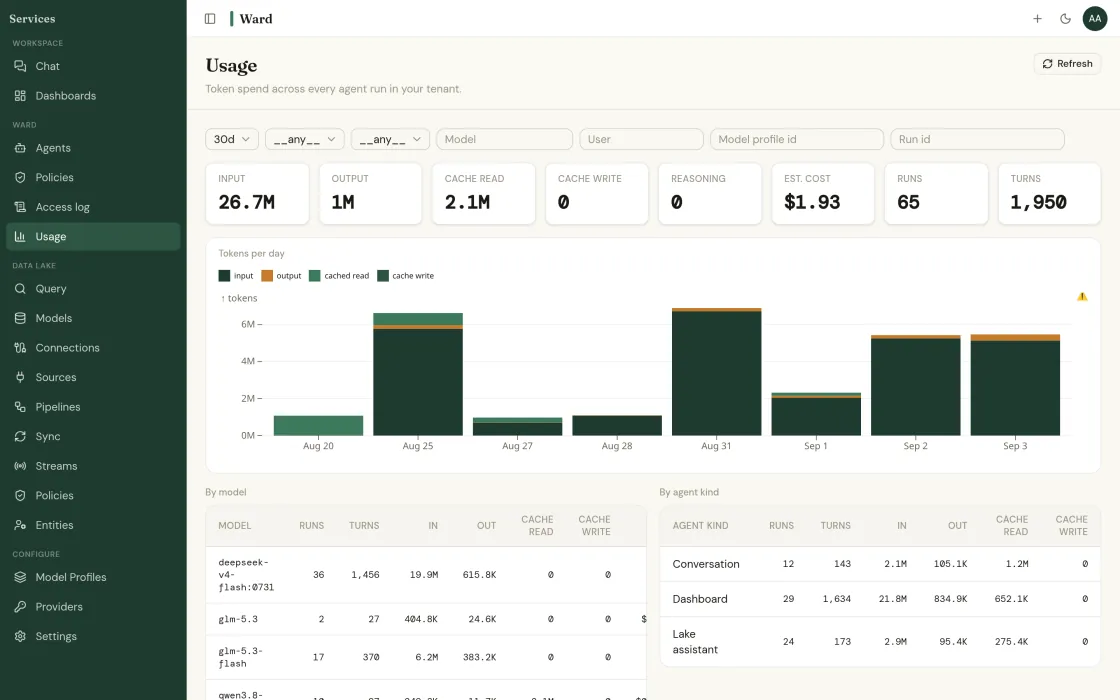
Input, output and cached tokens are counted on every call and attributed to the user, the agent and the department that spent them. The Usage page shows the month as it accrues.
-
Billed monthly, in arrears
One invoice at month end for 5% of the metered spend. Budgets and hard caps per department and per user are on the platform, so finance can bound it before it becomes a surprise.
| Line | Per month | Per year |
|---|---|---|
| Model spend, paid to your provider | $3,000 | $36,000 |
| Ward, 5% of that | $150 | $1,800 |
| Platform, seats, license | $0 | $0 |
The two screens below are a real tenant, not a mock. A month of agent runs came to $1.93 in tokens. Ward's share of that month was ten cents.
One-time. Only if you want our time.
The platform stands up in hours on its own. A setup package buys a named engineer for the part that takes weeks: connecting every source, getting the definitions right, wiring the first gated write, and training the people who will use it.
- Console guides and the quickstart
- Ward AI drafts sources, pipelines and policies; you approve
- Community support
- Document room: MSA, DPA, questionnaire, no call
- First two or three sources connected with you
- Semantic layer reviewed against the reports you already ship
- Two training sessions for the team that will use it
- 30 days of office hours after go-live
- Everything in Guided, across every source in scope
- Custom schema and KPI definitions for your vertical
- First gated write-back playbook against your approver role
- Security review support: questionnaire, architecture walkthrough
- Training per business unit, not one session for everyone
- Everything in Managed, per brand or legal entity
- Private VPC, customer-managed keys, data residency
- A solutions architect through go-live
- Quarterly enablement and an executive readout
What sets the setup scope.
The software does not change with your size. The amount of our time does.
A $20M group on three POS systems takes longer to deploy than an $80M single-brand DTC. Four things decide which package fits.
POS, ERP, WMS, e-commerce, loyalty, marketing, finance. More systems, more reconciliation work before the definitions agree.
One brand, a portfolio, or separate legal entities. Each entity needs its own schema, identity and compliance boundary.
Off-the-shelf, or custom fields and industry logic: fresh weights, seasonality, pharmacy compliance, royalties.
Shared tenancy or private VPC. A questionnaire, or SOC 1, SOC 2 evidence and data residency.
What you’re choosing between.
The four options every mid-market retailer actually weighs.
| Spreadsheets / DIY | Tableau + analyst | ThoughtSpot Enterprise | Palantir Foundry | Ward | |
|---|---|---|---|---|---|
| Annual cost | $0 visible | $30K tools + $140K analyst = $170K | $400K–$1M+ | $500K–$5M+ | $0 + 5% of compute |
| Setup time | None (you build forever) | 3–6 months | 4–6 months | 6–12 months | Hours |
| AI reasoning layer | None | None | Bolted-on, query-capped | Yes (you engineer it) | Native, multi-LLM |
| Retail-native schema | No | No | No | No (you build it) | Yes, out of box |
| Agentic workflows | No | No | Limited | Yes (engineered) | Yes, ready day 1 |
| Designed for mid-market | n/a | Sort of | No (Fortune 1000) | No (Fortune 100) | Yes |
| Hidden cost | 1–3% of revenue in avoidable stockouts, markdowns, overstaffing | Analyst burnout, dashboards no one uses | $50K–$200K data modeling consultants | 20–50% Y1 services uplift | None |
- Annual cost
- $0 to deploy, 5% of model spend
- Setup time
- Hours (write-back adds 4-6 weeks)
- AI reasoning layer
- Native, multi-LLM
- Retail-native schema
- Yes, out of box
- Agentic workflows
- Yes, ready day 1
- Designed for mid-market
- Yes
- Hidden cost
- None
- Annual cost
- $0 visible
- Setup time
- None (you build forever)
- AI reasoning layer
- None
- Retail-native schema
- No
- Agentic workflows
- No
- Designed for mid-market
- n/a
- Hidden cost
- 1–3% of revenue in avoidable stockouts, markdowns, overstaffing
- Annual cost
- $170K (tools + analyst)
- Setup time
- 3–6 months
- AI reasoning layer
- None
- Retail-native schema
- No
- Agentic workflows
- No
- Designed for mid-market
- Sort of
- Hidden cost
- Analyst burnout, dashboards no one uses
- Annual cost
- $400K–$1M+
- Setup time
- 4–6 months
- AI reasoning layer
- Bolted-on, query-capped
- Retail-native schema
- No
- Agentic workflows
- Limited
- Designed for mid-market
- No (Fortune 1000)
- Hidden cost
- $50K–$200K data modeling consultants
- Annual cost
- $500K–$5M+
- Setup time
- 6–12 months
- AI reasoning layer
- Yes (you engineer it)
- Retail-native schema
- No (you build it)
- Agentic workflows
- Yes (engineered)
- Designed for mid-market
- No (Fortune 100)
- Hidden cost
- 20–50% Y1 services uplift
Setup time is the warehouse standing up and answering questions. Wiring write-back into your systems of record is a further four to six weeks on a Managed setup, because that part is a security review and a set of approvals, not a data problem.
Spreadsheets look free and cost the most. Missed insights and drift between stores are the largest single expense in mid-market retail.
You’re not paying for software. You’re paying for the insights you can’t afford to miss.
Ward's share of a year of compute is under two thousand dollars in the example above. Here is what one missed insight costs the same retailer.
What you catch
| You catch | First-week impact | Annualized |
|---|---|---|
| One stockout day at one store | $500–$5,000 | $20K–$200K |
| One mispriced promo run | $20K–$80K | $80K–$320K |
| One quarter of staffing inefficiency | $7K–$20K | $30K–$90K |
| One vendor fill-rate dispute | $15K–$50K | $60K–$200K |
| One Category 7 markdown spiral | $30K–$100K | $120K–$400K |
Sources: NRF, IHL Group, RetailNext benchmarks for mid-market multi-location operators.
| Investment, year one | Cost |
|---|---|
| Managed setup, one-time | $20,000 |
| Ward compute fee, 5% of $3,000 a month | $1,800 |
| Model spend, paid to your provider | $36,000 |
| Platform, seats, license | $0 |
| Total Year 1 | $57,800 |
Of which Ward invoices $21,800. Year two, with no setup, is the compute fee alone.
| Return | Value |
|---|---|
| Stockout reduction (1.5% recovery on $40M) | $600K |
| Margin optimization (40 bps) | $160K |
| Labor / scheduling efficiency (2%) | $144K |
| Year 1 return (mid-case) | $904K |
The first stockout Ward catches pays for setup. The first promo conflict pays for a decade of compute.
Everything after that is margin you were not going to capture.
Common questions.
Five percent of the model compute that routes through it, and one-time setup packages. There is no third line. A platform that only earns when your agents are running has to make them worth running, which is the incentive we wanted.
The tokens your provider bills for on calls Ward made: input, output and cache reads, at the price on your provider account. Warehouse compute, storage and your own engineers' time are not in it. Nothing is counted twice, and nothing is counted that you cannot see on the Usage page.
Yes. Ward runs on the Anthropic, OpenAI or Google accounts you already hold, or on an endpoint inside your own VPC. You keep your negotiated rates and your data terms with the provider. Ward's 5% is invoiced separately, so the provider bill is exactly what it would be without us.
Per department and per user, on the platform. Alerts at 80%, then a hard stop or an overage approval, your call. Because Ward routes each question to the cheapest model that clears the quality bar, the cap bounds the spend without bounding what the business gets back.
No. Self-guided is the same software, and a technical lead with one source and an afternoon does not need us in the room. The packages exist for the part that takes weeks on a bigger stack: every source connected and reconciled, definitions agreed, the first gated write wired against your approver role, and the people who will use it trained. They are invoiced once, and moving from one to the next mid-deployment is the difference in price.
Per-user pricing punishes you for using the platform. The people who should be asking questions are store managers and category buyers, and a seat price is how they end up not asking. Ward is paid on what the questions cost to answer, so every team member is included.
Both are general-purpose platforms where you build the retail layer yourself, on an annual license. Ward ships retail-native schema, retail KPIs, and an agent that already understands stockouts, fill rates, promo conflicts and shrink, and it charges nothing until those agents run.
Deploy it. The bill is on this page.
Request access and connect a source, or take twenty minutes with an engineer to scope setup. No decks either way.
Want an engineer first? Book twenty minutes. Or take the contracts first: open the document room for the MSA, DPA and security questionnaire, no call required.
Control AI spend by department and user.
Without skimping on the outcome.
Give every department and every user a compute budget. Ward routes each question to the cheapest model that clears the quality bar, so finance caps the spend without capping what the business gets back.
Find out what your data has been hiding.
Tell us about your operation. We’ll show you the problems Ward catches, and the ones your current tools miss.